
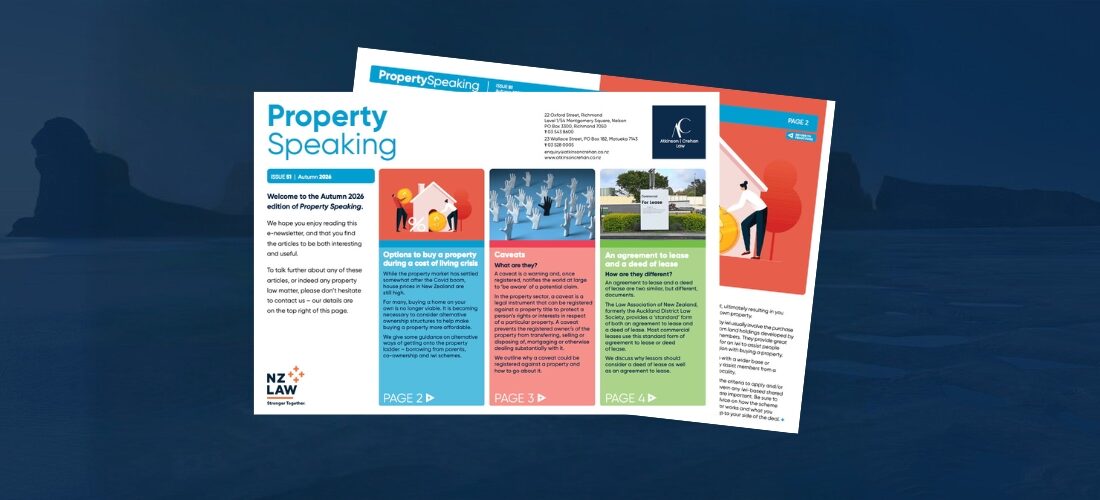
Property Speaking, Autumn 2026, No 51
Welcome to the Autumn 2026 edition of Property Speaking.
We hope you enjoy reading this e-newsletter, and that you find the articles to be both interesting and useful.
Options to buy a property during a cost of living crisis
While the property market has settled somewhat after the Covid boom, house prices in New Zealand are still high. For many, buying a home on your own is no longer viable. It is becoming necessary to consider alternative structures to help make buying a property more affordable.
Borrowing from parents
It is not a new concept, but the rise of house prices in New Zealand has meant that it is very difficult to buy a home without some extra financial help from mum and dad.
If this seems to be a realistic plan, it is important that both you and your parents get separate advice on how this could be structured.
Loans are an effective way for parents to help their children buy a home, without exposing those funds to relationship property losses. Lenders will often want money from parents to be a gift as part of a purchase. However, careful advice and structuring of money from the bank of mum and dad can mean that parents can provide financial assistance without fear of losing half of their money if a child and their partner separate.
It is possible for parental loans and bank loans to both exist in harmony provided you seek the right advice up front. You want to ensure all parties are protected before taking that first step to buy a property.
Co-ownership
Owning a home with a friend or relative to alleviate the rising costs is becoming a more common way for Kiwis to get onto the property ladder.
An important step to include as part of entering into co-ownership arrangements is to set out and define both parties’ understanding and expectations in respect of the property expenses, each party’s initial contributions and what happens if one of you dies, or wants or needs to sell their share?
These considerations are typically set out in what is called a property sharing agreement. Again, good advice before you buy a property with a friend or family member and comprehensive property sharing agreement will help both parties understand their own rights and obligations before it is too late. As well, it assists to preserve whatever relationship you have with your co-owner if you do decide to go your separate ways.
Property sharing agreements can cover a range of co-ownership relationships from parent/child, siblings, other more remote family relationships or friends. Co-ownership in a de facto or spousal relationship, however, requires different specialist advice. Before you dive into buying a property with your friend, speak to us about ensuring both parties are protected and go into the venture fully aware of what you are getting into.
Iwi schemes
There are now a range of iwi schemes available for Māori to enter into shared equity ownership with either a scheme provider or their local iwi.
The criteria to qualify for these schemes differs depending on the scheme, but usually these are predominantly based on whether or not you whakapapa to a particular iwi, along with requiring some financial assistance to buy your first home.
The iwi or scheme provider buys a share of the property with you on specifically drafted terms that govern your shared ownership. These also usually include a timeframe in which you are meant to buy out the iwi or scheme provider from the shared equity arrangement, ultimately resulting in you owning your own property.
Schemes run by iwi usually involve the purchase of property from land holdings developed by the iwi for its members. They provide great opportunities for an iwi to assist people within their region with buying a property.
Other schemes with a wider base or catchment may assist members from a range or iwi or locality.
Understanding the criteria to apply and/or the rules that govern any iwi-based shared equity schemes are important. Be sure to contact us for advice on how the scheme that you qualify for works and what you have to do to keep to your side of the deal.
Caveats
What are they?
A caveat is a warning and, once registered, notifies the world at large to ‘be aware’ of a potential claim.
In the property sector, a caveat is a legal instrument that can be registered against a property title to protect a person’s rights or interests in respect of a particular property. A caveat prevents the registered owner/s of the property from transferring, selling or disposing of, mortgaging or otherwise dealing with it.
Why register a caveat?
The caveator must have a ‘caveatable interest’ in the property. The legislation[1] specifies the situations in which a caveatable interest may exist. If you think you may have a caveatable interest in a property, we encourage you to talk with us about your particular situation.
One common scenario in which caveats are registered is when a person dies and the executors of their will are in the process of transferring or otherwise dealing with the deceased person’s property. The deceased’s former partner or spouse may register a caveat against the deceased’s property to protect their interests and their right to bring any claims under the Property (Relationships) Act 1976. This is particularly common in situations where executors are unwilling to cooperate or consider such claims.
Another situation in which caveats are commonly registered is where a person is a beneficiary of a trust and has an expressly recorded entitlement to a particular property or piece of land. That beneficiary may wish to prevent their entitlement from being transferred or otherwise dealt with, and so may register a caveat to protect their proprietary interest.
[1] Section 138(1).
It is important to keep in mind that registering a caveat is not a decision that should be made lightly. There are serious potential consequences for the caveator if a caveat is improperly registered. The Act[1] allows people affected by the registration of a caveat to claim compensation for loss or damage against the person who registered it, especially where there was no caveatable interest to begin with. Lawyers can also face liability and be penalised for assisting their client to register a caveat where there is no caveatable interest. Claims for compensation are heard and determined by the High Court.
One situation in which people may seek to claim compensation is when the sale of the property has been impacted or delayed by the registration of a caveat, and there were no reasonable grounds to justify the registration of the caveat or sustain one in the first place. Affected people may apply to the court for compensation for loss or damage. This compensation could include an award of compensatory damages (to compensate and restore the claimant to the financial position they would have been in had the caveat not been registered) and, in extreme cases, punitive damages (designed to punish the caveator).
Registering a caveat
Once you have confirmed a caveatable interest in a particular property, you should discuss with us about registering that caveat. We will prepare and ask you to sign an Authority and Instruction Form. This confirms your instructions and facilitates registration of the caveat on the Land Information New Zealand (LINZ) database.
When can caveats be removed?
There are three situations in which caveats are removed:
- By consent
- If the caveat lapses, or
- By a court order.
[1] Section 148.
More commonly, caveats are removed when the parties have set aside their differences, and the caveator may decide to withdraw the caveat from the property title.[1]
Further, the Act[2] provides that a caveat may lapse following an application made by an affected person, usually the registered owner of the property, to the Land Transfer Registrar, unless a specific and timely response is received from both the caveator and the court. The caveat will lapse unless the caveator makes an application to the court within 10 working days to sustain the caveat, and the court makes one of three types of order within a further 20 working days. The orders the court can make include an interim or temporary order that the caveat not lapse, a final order or an order postponing the caveator’s application for the time being.
As well, the Act[3] confirms that a person who has an estate or interest affected by a caveat may apply to the court for an order that the caveat be removed. This means that the registered owner, for example, may apply to the court rather than to the Land Transfer Registrar seeking removal of the caveat. Claims for compensation for loss or damage may also be made at the same time.
In summary, a caveat is a robust tool for protecting one’s rights and interests over real property. It is important to receive sound legal advice on the effects and implications of registering a caveat, due to the risks and consequences associated with registering one incorrectly.
[1] Section 144.
An agreement to lease and a dead of lease
How are they different?
Agreement to lease
An agreement to lease sets out the main commercial terms of a lease, such as the term, annual rent and rights of renewal. It can also contain further details regarding the fitout and other alterations which the tenant intends to do to ensure the premises are suitable for its business use. It can also set out how the cost and ownership of the fitout and alterations will be met between landlords and tenants.
Agreements to lease can often be conditional agreements while the tenant works through a due diligence process to ensure the property is suitable for its intended use, or to ensure that it can obtain the necessary territorial authority consents to operate its business.
Once any conditions have been satisfied, the agreement to lease is a binding agreement between the landlord and tenant; it can only be cancelled in accordance with the terms of the agreement. An agreement to lease states that a tenant must enter into a deed of lease on the standard TLANZ form once prepared by the landlord.
Deed of lease
Like an agreement to lease, the deed of lease also sets out the main commercial terms of the lease, such as the term, annual rent and rights of renewal. It goes further than the agreement to lease; it allows a tenant to assign the lease and additional terms set out the position in relation to the day-to-day management of the lease, such as maintenance obligations for both the landlord and the tenant, and what happens at the end of the lease.
Why you should also enter into a deed of lease
An agreement to lease does not allow the tenant to assign its interest in the lease. However, a deed of lease does allow this. If a tenant wishes to sell its business, they will need to enter into a deed of lease to have the benefit of the assignment provisions in the deed of lease. If the tenant wants to obtain bank lending for its business, the lender may want to see the deed of lease, and may require that a deed of lease is entered into as part of its financing approval.
The agreement to lease provides that the parties will enter into a deed of lease on the ‘then current’ form of deed of lease.
Most importantly, the agreement to lease also incorporates all of the terms of the standard deed of lease, so the landlord and tenant are agreeing to be bound by a document they have not seen or signed. In particular, if the parties have not received legal advice before entering into the agreement to lease, they may not have full knowledge of the terms of the deed of lease and what they have agreed to, and may find that the obligations in the deed of lease are not as they expected.