
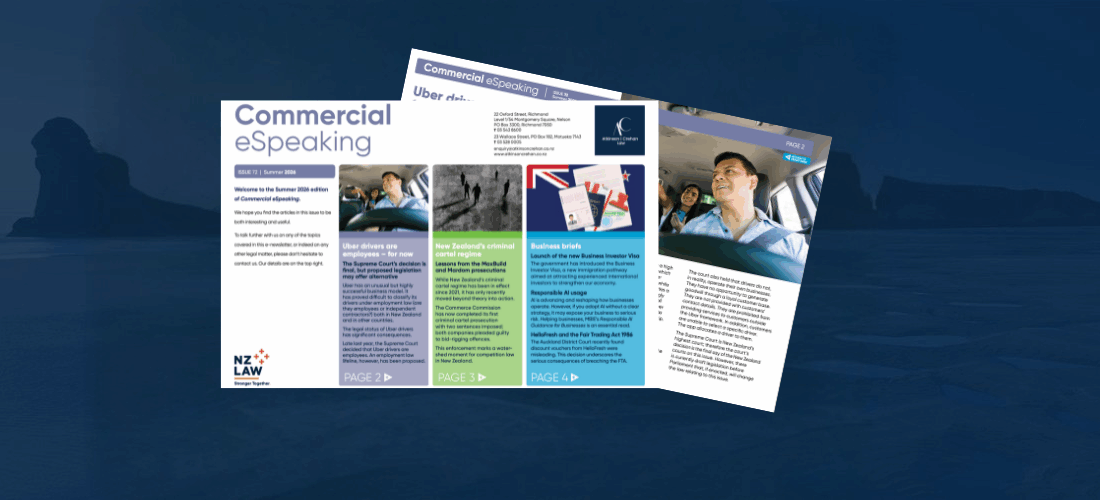
Commercial eSpeaking, Summer 2026, No 72
Welcome to the Summer 2026 edition of Commercial eSpeaking.
We hope you find the articles in this issue to be both interesting and useful.
To talk further with us on any of the topics covered in this e-newsletter, or indeed on any other legal matter, please don’t hesitate to contact us.
Uber drivers are employees – for now
The Supreme Court’s decision is final, but proposed legislation may offer an alternative
Uber has an unusual but highly successful business model. It has proved difficult to classify its drivers under employment law, both in New Zealand and in other countries where it operates.
Employees vs independent contractors
The issue is whether Uber’s drivers are employees or independent contractors. The legal status of Uber drivers has significant consequences.
Employees have a range of statutory entitlements, including annual leave, sick leave, bereavement leave, employer contributions to KiwiSaver, minimum wage levels, and the right to join a union and engage in collective bargaining with their employer.
Independent contractors have none of these rights. However, they are entitled to offset their expenses against their income for tax purposes. Employees cannot do this.
The New Zealand court system has been grappling with this issue for the last five years. In 2021, the Etū union filed proceedings in the Employment Court seeking a declaration that four Uber drivers were employees. The Employment Court ruled in the union’s favour, declaring that the drivers were employees. Uber appealed to the Court of Appeal. The Court of Appeal declined the appeal. Uber sought, and was granted, permission to appeal to the Supreme Court. The Supreme Court released its decision on 17 November 2025.
Supreme Court decision
The Supreme Court upheld the Employment Court’s decision that Uber drivers are employees. The court applied the well-established test for determining whether workers are employees set down in the Bryson case. Bryson considered the issue of whether crew members on ‘The Lord of the Rings’ film project were employees or independent contractors. The test derived from this case involves considering the intention of the parties (how they describe their arrangement), the degree of control the company has over the worker, the extent to which the worker is integrated into the company’s business and whether the worker can realistically be said to have their own business.
Uber’s contractual documentation avoids the terms employee and independent contractor altogether. Uber claimed that it merely provided a service to drivers and riders by matching them through its app. The Supreme Court found that this documentation did not reflect the true position and that, in reality, Uber was using its drivers to provide transport services to its customers.
The court found that Uber exerts a high degree of control over its drivers, which suggests they are employees. Uber monitors the location of its drivers while they are using the app. Uber operates a reward system for drivers that strongly encourages them to accept nearly all the trips offered to them. Once a driver accepts a trip, Uber specifies the route they must take and the price for the trip.
The court accepted that drivers are not integrated into Uber’s business in the traditional sense. They do not wear uniforms or have Uber branding on their vehicles. The court found, however, that the drivers are integrated into Uber’s business in the sense that they are the ‘face’ of Uber’s business. The drivers are the only individuals that customers have contact with when buying services from Uber.
The court also held that drivers do not, in reality, operate their own businesses. They have no opportunity to generate goodwill through a loyal customer base. They are not provided with customers’ contact details. They are prohibited from providing services to customers outside the Uber framework. In addition, customers are unable to select a specific driver. The app allocates a driver to them.
The Supreme Court is New Zealand’s highest court; therefore the court’s decision is the final say of the New Zealand courts on this issue. However, there is currently draft legislation before Parliament that, if enacted, will change the law relating to this issue.
The proposed ‘gateway test’
The Employment Relations Amendment Bill includes a proposed ‘gateway test.’
The Bill lists five criteria for the gateway test. If a worker’s contract meets all five criteria, then they will be deemed to be an independent contractor, and they will be unable to take legal action to be treated as an employee.
However, if the contract does not meet all five prerequisites, then their status may be decided by the courts using the tests applied in the Uber case.
The five elements of the proposed gateway test are currently:
- The contract defines the worker as an ‘independent contractor’
- The worker may work for other parties (except while working for the other party to the contract)
- The worker is not required to work set hours, or may subcontract their work to others
- The contract does not end if the worker refuses additional work, and
- The worker had the opportunity to take independent legal advice before signing the contract.
The Bill passed the select committee stage at the end of last year and has returned to Parliament for its second reading.
It is unknown when the Bill will become law, as this will depend on how the government chooses to prioritise the legislation currently before Parliament. However, when the Bill is passed, it will enable companies to be certain that their workers are independent contractors, provided their agreements with their workers meet the requirements of the gateway test.
In the meantime, however, the test for whether someone is an employee or a contractor is well established. If you need some help with sorting out your current work situation, please don’t hesitate to contact us.
New Zealand’s criminal cartel regime
Lessons from the MaxBuild and Mardom prosecutions
While New Zealand’s criminal cartel regime has been in effect since 2021, it has only recently moved beyond theory into action.
The Commerce Commission has now completed the country’s first criminal cartel prosecution with two sentences imposed in the High Court in Auckland on construction companies MaxBuild Limited (MaxBuild) and Mardom Limited (formally Chelsea Contracting Limited) (Mardom), with both companies pleading guilty to bid-rigging offences.
This enforcement marks a watershed moment for competition law in New Zealand, and sends a clear message to all businesses engaged in tendering, procurement and competitor interaction.
Criminal conduct
The prosecutions arose from alleged bid-rigging in relation to NZ Transport Agency’s Northern Corridor Improvement Project and Auckland Transport’s Middlemore Bridge Refurbishment Project; two publicly funded infrastructure projects.
The commission’s investigation revealed that MaxBuild’s director, Munesh Kumar, colluded with Mardom’s director, Dominic Sutherland, by agreeing that Mardom would submit artificially high tenders (‘cover pricing’) to allow MaxBuild to win the contracts with lower bids. This practice undermines competitive tendering, harms procuring agencies and potentially loads costs onto taxpayers.
The scheme was accidentally uncovered when a spreadsheet containing details of the illicit arrangement was inadvertently included in tender documents sent to the project’s overseers. This triggered a formal commission investigation and, ultimately, criminal charges.
Sentencing
In December 2024, the High Court sentenced MaxBuild’s director to six months’ community detention and 200 hours’ community service, and ordered a $500,000 fine on MaxBuild for its role in facilitating the cartel conduct. Justice Wilkinson-Smith described the behaviour as ‘serious and deliberate,’ and an attack on business confidence and taxpayer trust.
More recently, in October 2025, the High Court imposed a $30,000 fine on Mardom following its guilty plea to cartel conduct.
Justice Sally Fitzgerald indicated that a starting fine of $595,000 would have been appropriate for Mardom, but the fine was lowered to $30,000 due to Mardom’s poor financial position and lack of active trading. Despite not directly benefiting financially from the scheme, the company had ‘taken active steps in the collusive behaviour.’
In both prosecutions, mitigating factors such as early guilty pleas, cooperation, personal circumstances and the inability to pay influenced the level of penalties imposed.
Why this matters for New Zealand businesses
Under New Zealand law, intentional cartel behaviour – including price-fixing, market allocation, restricted output arrangements and bid-rigging – can attract:
- Up to seven years’ imprisonment (for individuals), and/or fines of up to $500,000, and
- Substantial corporate fines (up to the greater of $10 million, three times commercial gain or 10% of turnover for each year in which a breach occurred).
The cases of MaxBuild and Mardom demonstrate that:
- The commission will deploy criminal powers when warranted – not just civil penalties
- Bid-rigging and cover pricing are key priorities, particularly in public-sector procurement
- Individuals face personal exposure, with directors who engage in or facilitate cartel conduct risking criminal convictions and custodial sentences, and
- Early guilty pleas and cooperation can reduce sentences, but they do not prevent convictions.
Lessons for business
- Train your staff on ‘informal’ competitor contact. Conversations about pricing, bid strategy, territories or customers with competitors can be high-risk
- Establish compliance programmes for your tender applications and keep them updated. Any coordinated arrangements with competitors about bidding practices can easily amount to cartel conduct. Include cartel law training, procurement protocols and escalation points for suspected breaches, and
- Be proactive if you suspect there has been a breach. The commission’s Cartel Leniency and Immunity Policy (here) can be a way to mitigate exposure if cartel conduct is disclosed early.
Cartel conduct will be pursued aggressively
The commission’s prosecutions of MaxBuild and Mardom represent a tipping point in New Zealand’s competition law enforcement. It underlines that cartel conduct, particularly in tender processes involving public funds, will be pursued aggressively, with potential criminal consequences.
For businesses operating in competitive markets, strong competition law governance is essential to protect legal, financial and reputational risk.
If you are unsure about any aspect of competitive commercial tenders, please contact us at the earliest opportunity.
Business briefs
Launch of the Business Investor Visa
The government has introduced the Business Investor Visa (BIV), a new immigration pathway aimed at attracting experienced international investors to strengthen New Zealand’s economy. The launch of the BIV follows the closure of the Entrepreneur Work Visa and represents a significant shift toward sustained investment in established New Zealand businesses.
The BIV offers two residency pathways:
- Work-to-residency (3 years) – minimum investment threshold of $1 million, or
- Fast-track residency (12 months) – minimum investment threshold of $2 million.
Investments must be directed into an existing, actively operated New Zealand business. Other key requirements include demonstrated business experience by the investor, investment in a business that employs at least five full-time staff, and compliance with approved and qualifying business categories.
For New Zealand business owners, the BIV presents an opportunity to attract new capital, expand operations and generate employment that, in turn, will promote long-term economic growth.
Responsible AI usage
AI is advancing and reshaping how businesses operate. However, if you adopt AI without a clear strategy it may expose your business to serious risk – including, without limitation, bias, errors, privacy breaches and cybersecurity threats.
To help businesses navigate this, the Ministry of Business, Innovation and Employment has released Responsible AI Guidance for Businesses. The Guidance outlines practical steps to ensure AI use is responsible and aligns with your commercial goals, legal obligations and ethical standards.
Key recommendations include:
- Defining your purpose for using AI and starting with low-risk projects
- Maintaining human oversight to prevent errors and unintended consequences
- Reviewing governance, risk management and compliance processes
- Choosing trusted AI providers and implementing strong data protection methods, and
- Training staff to understand AI’s capabilities and limitations.
For a more comprehensive overview, we encourage you to read the Guidance and consider seeking legal advice to protect your business as you implement AI. While AI can deliver significant benefits, successful implementation requires a cautious and comprehensive approach.
HelloFresh and the Fair Trading Act 1986
In the Winter 2025 edition of Commercial eSpeaking, we reported on the Commerce Commission’s allegations against HelloFresh for misleading conduct under the Fair Trading Act 1986 (FTA).
The commission’s prosecution focused on an 18-month cold call campaign, during which former customers of HelloFresh were offered discount vouchers without a clear explanation that accepting those offers would result in subscriptions being reactivated, consequently triggering customer account charges.
Recently, in the Auckland District Court, it was found that the way the discount vouchers were presented created a misleading overall impression for former customers. HelloFresh was fined $845,000 as a result.
The above decision underscores the serious consequences of breaching the FTA. This is particularly relevant now, as the government has proposed to substantially increase the penalties for non-compliance. At present, the maximum penalties for misleading and deceptive conduct under the FTA are capped at $200,000 for individuals and $600,000 for businesses. The proposal to increase these limits will allow penalties to reach the greater of:
- $1 million for individuals
- $5 million for businesses
- Three times the value of any commercial gain or loss avoided, or
- The value of the transaction(s) involved.
Although a new civil regime will also apply for most breaches, the most serious or deliberate conduct will remain a criminal offence. These changes are expected to take effect by late 2026.
This announcement marks a significant increase in potential liability, emphasising the need for businesses to ensure advertising, pricing and promotional terms are accurate and transparent. Disclaimers buried in fine print may not be enough to correct misleading impressions. With penalties expected to become significantly higher, compliance with the FTA is essential to avoid financial and reputational consequences.