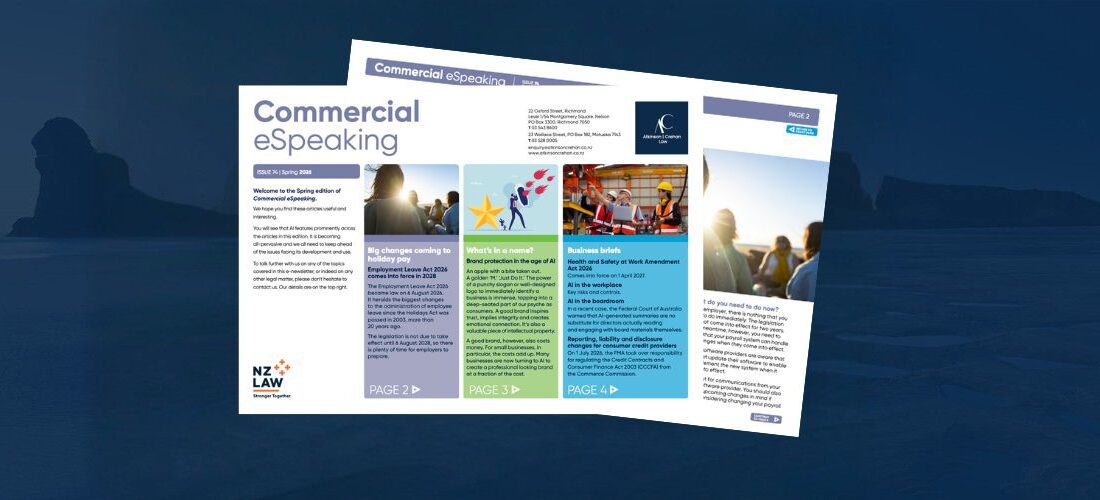
Commercial eSpeaking, Spring 2026, No 74
Welcome to the Spring 2026 edition of Commercial eSpeaking.
We hope you find these articles useful and interesting.
You will see that AI features prominently across the articles in this edition. It is becoming all-pervasive and we all need to keep ahead of the issues facing its development and use.
To talk further with us on any of the topics covered in this e-newsletter, or indeed any other legal matter, please don’t hesitate to contact us.
Big changes coming to holiday pay
Employment Leave Act 2026 comes into force in 2028
The Employment Leave Act 2026 became law on 6 August 2026. It heralds the biggest changes to the administration of employee leave since the Holidays Act was passed in 2003, more than 20 years ago. The legislation, however, is not due to take effect until 6 August 2028, so there is plenty of time for employers to prepare.
Why is it changing?
The current system has proved to be complex and especially challenging to apply to employees who have variable working hours or variable pay through commissions. This has led to a number of well-publicised instances of large public sector organisations having incorrectly paid a large number of their employees for their leave over a substantial period. It is likely that this has happened in the private sector as well.
The situations which have occurred in the public sector have garnered more publicity, given the transparency that applies to public sector organisations.
For example, Health New Zealand, that took over from the 24 former district health boards, is currently going through a complex process of identifying and correcting errors with holiday pay dating back to 2010. Health New Zealand has budgeted $1.8 billion to make up previous short payments to its staff for leave. It is also spending tens of millions of dollars on the investigative and administrative work associated with identifying and correcting these errors.
What is changing?
The fundamental change to be introduced is a switch to calculating leave on an hourly basis. The Act also distinguishes between ‘standard hours,’ ‘additional hours’ and ‘casual hours.’ Broadly, ‘standard hours’ are an employee’s ordinary hours, while ‘additional hours’ are hours worked beyond those standard hours. ‘Casual hours’ are hours worked by a casual employee. The legislation retains the ability for an employment agreement to state that an employee’s salary covers all hours worked.
The general rule will be that annual leave will accrue at the rate of 0.0769 hours for each hour worked. Sick leave will accrue at the rate of 0.0385 hours.
Other significant changes include:
- Employees will accrue both annual and sick leave as soon as they begin working. They will no longer have to work for a year before being entitled to annual leave and six months before being entitled to sick leave
- Employees will only accrue annual leave for their normal working hours. They will not accrue leave for any additional hours worked. Instead, they will receive an immediate payment of 12.5% of their normal hourly rate for all qualifying hours worked in excess of their normal working hours
- Employees will be able to take both annual and sick leave on an hourly basis. They may take one or two hours off work for a medical appointment. Under the current law, technically, they may be required to take a full day’s leave for this
- Both annual and sick leave will accrue when an employee is on paid leave or any unpaid leave authorised by any legislation, including parental leave. Leave will not accrue, however, when an employee is receiving accident compensation support
- An employee will accrue additional leave for each hour that they work on a public holiday if that day is a normal working day for them, and
- Employers and employees will be able to agree for employees to ‘cash out’ up to 25% of the value of the annual leave. At present, the limit is one week’s leave.
What do you need to do now?
As an employer, there is nothing that you need to do immediately. The legislation does not come into effect for two years. In the meantime, however, you need to ensure that your payroll system can handle the changes when they come into effect.
Payroll software providers are aware that they must update their software to enable it to implement the new system when it comes into effect.
Watch out for communications from your payroll software provider. You should also bear the upcoming changes in mind if you are considering changing your payroll system.
You must also update the leave provisions in your employment agreements. The Act allows employers a further year after the legislation comes into force on 6 August 2028 to ensure that all employment agreements are updated.
Employers must continue to comply with any provisions in their employment agreements that are more favourable to employees than the Act during this first year. The minimum statutory terms will override any employment agreement that remains unchanged at the end of this period.
If you need guidance on updating your staff’s employment agreements, or any other aspects of this new legislation, please don’t hesitate to contact us.
What’s in a name?
Brand protection in the age of AI
An apple with a bite taken out. A golden ‘M.’ ‘Just Do It.’ The power of a punchy slogan or well-designed logo to immediately identify a business is immense, tapping into a deep-seated part of our psyche as consumers. A good brand inspires trust, implies integrity and creates emotional connection. It’s also a valuable piece of intellectual property.
A good brand, however, also costs money. Marketing and advertising, graphic design and social media experts: it all adds up, particularly for small businesses where every dollar counts. That is why many businesses are turning to the latest tech toy – generative AI. ChatGPT and other AI tools can create professional-looking branding in seconds for a tiny fraction of the market cost.
Under OpenAI’s terms of use, you own any output generated by ChatGPT or its other applications based on prompts or information you input,[1] meaning you potentially own a piece of intellectual property which can contribute to the value of your business. Logos or slogans created by AI might even qualify to be registered as trade marks.
So what’s the risk?
Trade marks have been used and relied upon for hundreds of years by traders seeking to distinguish the goods or services they offer from those of other businesses. They attract a goodwill value to a business as a recognisable symbol of the products on sale, as well as providing an enforceable means of protection against less scrupulous traders who might seek to sell the same or similar products under a pretence of connection.
Under the Trade Marks Act 2002, to be eligible for registration, a trade mark must:
- Have a distinctive character.[2] It cannot just be a description of goods or services, and
- Not be similar to an existing trade mark for similar goods or services, or otherwise be likely to cause confusion.[3]
Even without registration, a business may have protection under the common law tort of passing off, as well as under provisions of the Fair Trading Act 1986 that prohibit misleading or deceptive conduct and certain conduct concerning trade marks.
OpenAI gives no warranty or representation, however, that the brand it creates will meet trade mark eligibility criteria, or be sufficiently distinctive to you to justify a passing off claim. In fact, its Terms of Use expressly acknowledge that due to the nature of the services provided, outputs may not be unique, and ‘other users may receive similar output.’ This means there is no guarantee that your AI-generated brand will not be the same as or similar enough to someone else’s mark to cause confusion, limiting its value as a trade mark in terms of goodwill and reducing its enforceability against potential fraudsters.
Using generative AI to create a brand might also leave you open to trade mark infringement or passing off claims by existing trade mark owners. OpenAI’s terms expressly state that a user is responsible for their own output, including that it does not violate any applicable laws.
ChatGPT does not run any clearance checks to ensure that the branding that it generates for a user does not use or infringe the intellectual property of any other party.
Generative AI models are trained using large datasets, which may include material created by third parties. The legal implications of that training, and of particular AI-generated outputs, are still developing. Businesses should therefore not assume that AI-generated material is free from third-party intellectual property risks.
[1] https://openai.com/en-GB/policies/terms-of-use/
[2] Trade Marks Act 2002, s18.
[3] s17(a).
No legislative guidance here
For now, the onus is on you to ensure that your AI-generated branding is sufficiently distinctive and original – not only to provide the goodwill value of a trade mark, but also to protect your business against passing off claims. MBIE has published voluntary guidance for businesses on the responsible use and development of AI. To read this, click here.
To ensure protection against passing off and defence against third party infringement claims, getting our advice will be your safest bet.
Business briefs
Health and Safety at Work Amendment Act 2026
Since we published the Winter 2026 edition of Commercial eSpeaking, the Health and Safety at Work Amendment Act 2026 has received Royal Assent and will come into force on 1 April 2027.
The Act introduces ‘critical risk’ as a defined concept – being risks associated with hazards under Schedule 1A or risks likely to result in death, notifiable injury, illness, incident or occupational disease, and requires businesses to prioritise managing these risks above others.
If you employ fewer than 20 people, your health and safety duties will narrow specifically to critical risks, rather than covering every possible workplace risk. You’ll still need to meet baseline obligations, including providing adequate employee facilities (for example: toilets, drinking water and hand-washing facilities) but this change is intended to reduce the compliance burden for smaller businesses.
The Act also clarifies the duty owed by a Person Conducting a Business or Undertaking (PCBU) where its workplace includes outdoor space used for recreation. In specified circumstances, the PCBU will not owe the usual section 37 duty to people entering and using that space for recreational purposes, unless:
- The recreational use is part of a PCBU’s business or undertaking, or
- Other work connected to a business or undertaking conducted by the PCBU is being carried out at the time in the outdoor space near where the entry and use are taking place.
If your business already complies with industry-specific legislation, the Act confirms this will satisfy your obligations under the Act too, without needing to separately comply with the Act.
Businesses should begin reviewing their health and safety processes and policies now, ahead of the 1 April 2027 commencement date.
AI in the workplace
AI tools are becoming a standard part of many workplaces, used for everything from drafting documents to customer service and research. Used safely, AI may increase efficiency, but it is important to manage the associated risks and put the right safeguards in place.
Some key risks in practice include, without limitation:
- Confidentiality: Trade secrets or confidential information entered into an AI tool could be disclosed, retained or used to train the tool
- Privacy: Entering personal information into an AI tool may amount to a disclosure under the Privacy Act 2020
- Intellectual property: AI-generated content isn’t automatically free of copyright issues, and outputs may infringe someone else’s protected work, and
- Human oversight and transparency: AI output should be reviewed before it’s relied on, to guard against errors, bias or hallucinated content.
Some practical controls may include, without limitation:
- Paid subscriptions: Paid subscriptions to AI tools generally offer stronger safeguards than free versions, but your business will need to check the specific terms that apply
- Data audit: To take stock of what data the business holds, who can access it and whether use of an AI tool would give people wider access than they’re meant to have, and
- AI policy: To set clear expectations around which AI tools are approved for use, what types of information staff can and cannot put into them and the process for reviewing and signing off on AI-generated output before it’s relied on.
There is more guidance in the Ministry of Business, Innovation and Employment’s publication Responsible AI Guidance for Businesses. Click here to read it.
AI in the boardroom
A recent Federal Court of Australia decision has offered a timely warning on AI’s growing role in the boardroom.[1]The court also commented on AI use, warning that AI-generated summaries are not a substitute for directors actually reading and engaging with board materials themselves.
While the decision is not binding in New Zealand, directors here are subject to their own duty of care under the Companies Act 1993 that requires directors to exercise the care, diligence and skill of a reasonable director.
This duty applies regardless of whether AI is involved in a director’s decision-making process. If a director relies heavily on an AI-generated summary without checking it against the underlying material, they may struggle to demonstrate that they exercised the care, diligence and skill required by the Act.
As AI becomes more prominent in board processes and decision-making, this is a useful reminder that directors must properly engage with information and exercise independent judgement rather than relying solely on AI-generated material.
Reporting, liability and disclosure changes for consumer credit providers
On 1 July 2026, the Financial Markets Authority (FMA) took over responsibility for regulating the Credit Contracts and Consumer Finance Act 2003 (CCCFA) from the Commerce Commission. As part of this change, consumer credit providers including banks, credit unions and other lenders are now licensed under the Financial Markets Conduct Act 2013 (FMCA).
Reporting
Section 412 of the FMCA requires licensees to inform the FMA as soon as they believe they’ve breached, or are likely to breach, a licence obligation or if there has been, or is likely to be, a material change in circumstances, or where certain particulars are false or misleading.
While other types of FMCA licensees have been subject to this for years, this is new
for consumer credit providers who have not had to comply with this until now.
The obligation to report arises as soon as the licensee believes a breach may have happened or may be about to happen. Getting this timing wrong, or failing to report at all, can result in a penalty of up to $600,000.
Director and senior manager liability
Directors and senior managers of consumer credit providers no longer have a personal due diligence obligation under the CCCFA. Personal liability arises instead under the existing FMCA regime and requires involvement in a breach.
Disclosure
Under the CCCFA, courts may order a debtor not liable for borrowing costs where appropriate disclosures have not been made by consumer credit providers. This is triggered by way of application from a debtor or the FMA, where courts may consider factors including, without limitation, the provider’s compliance programmes and prejudice caused to the debtor.
For more detailed information about these changes, click here.